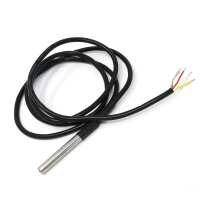
“The are very good sensors, forget the D11/22.
However, very expensive and I paid a lot extra for a single resistor but I wanted them quickly to develop some software.
Three more in the post from a very much cheaper source and also a bunch of pull-up resistors for about a quid. That's more like it!
I doubt this review will see the light of day but I wrote it as it is.”
“All seems to work nicely using sketch-lite. Add "dtoverlay=w1-gpio,gpiopin=16" in /boot/config.txt then modprobe w1-gpio and w1-therm then cat /sys/bus/w1/devices/28*/w1_slave to read the temperature from gpio pin 16 (avoids lcd connector). It remains to be seen if the 3.3v or 5v voltage drop over 10m or so is enough to stop it working.”
“I have a number of these DS18B20 (3 wire) sensors. You can easily connect them to a Raspberry pi in a python program using an interface called W1ThermSensor. This sensor seems to work well over long cables. An alternative (4 wire) sensor MCP9808 maybe more accurate, but you are limited in cable length (a couple of metres or so) before you get read errors.”
“Easy to wire and set up, well supported by the RPi3. A great and reliable sensor and the perfect way to start learning about computing, circuits and technology.”