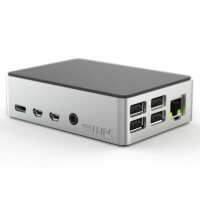
“The case is beautifully made and fits well but does not allow any GPIO, display or camera access. Great if you want a NUC PC like case rather than hobbyist.”
“I was worried that non-fan case would overheat, but loved the FLIRC case for my Pi3 so much, had to try the Pi4 version. Turns out to be mildly warm, no hotter than the Pi3. Was cheapest from PiHut and came fast once it was back in stock. Would give 6 stars if it was possible.”
“Easy to assemble and the intrinsic heatsink is just the ticket. Some nice little touches like discrete access to the SD card slot and precision engineered access slots for the connectors.”
“I have given this case 4 out of 5.
Excellent 5/5 for heat dissipation
Excellent 5/5 for build quality/materials
Excellent 5/5 or aesthetics
It only has one serious flaw (that I have found so far) hence the loss of a star.
My PI 4 WiFi performance as measured via the Internet speed is significantly degraded. Prior to purchase I'd not seen any reports of this drawback. Surely I’m not the only one experiencing this ?
FYI, I am connecting to a bog standard 2.4GHz WiFi hub. My home Internet bandwidth is nothing to write home about @ typically 30Mb/s and it is more or less the same anywhere in my house. But with the FLIRC case fitted to my PI 4, this goes down to 12Mb/s . It is not the PI 4, it is the case. A wee experiment with the naked PI 4 in exactly same location records the “standard” 30Mb/s. I suppose this shouldn’t be too much of a a surprise, as the case being 80%+ metal, acts as an imperfect Farraday cage, shielding a proportion of all EMF emissions. The PI WiFi stats (measured via ifconfig output) don’t indicate any specific transmission or signal strength issue and as yet I have no other handle on the problem. Suffice to say the PI 4 in a FLIRC case has it’s effective Internet bandwidth degraded. If I want the bandwidth back I suppose I will could use the hardwire Ethernet connection or maybe fit an external WiFi dongle.
All that being said I am happy with my choice of case. I think passive cooling is much preferable to active cooling (if it is not needed). My PI 4 in its FLIRC has never been above 50 degC so no need for active cooling IMO.”