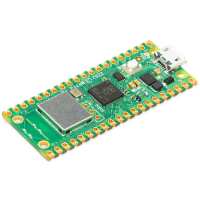
“These (I bought a few) arrived well packaged, intact and operational, so no complaints there.
I nearly took off a star because the delivery experience wasn't great, but that was Royal Mail's fault - poor tracking system, poor customer service, etc. - so I decided not to. The Pi Hut have always been great, and when I told them of the Royal Mail issue, they were helpful and reassuring, so can't ask for much more.”

“Using it to learn Python and electronic mechanisms and it sure is great for it.
Connect it to a breadboard and it soon becomes a great SBC to either try your first ever LED blinker or your own mini robot.
Having a wireless connection allows you to develop your own technology without having the Pico connected to your computer with a cable.
That may not sound like much but when you are developing a reversing ultrasonic sensor for your car and you want to do adjustments without having to remove everything or creating a medium sized servo mechanism controlled gyroscopically then it does make it a lot easier. Especially since you want it to switch on and run without any input.
With a bit of imagination, you can make anything you want (within reason of course).
All in all, a great board for beginners and pro's alike.”
“I Purchased a Pico-W to drive the Waveshare 'Nixie' Clock. The Pico-W looks to be a good microcontroller though I am not convinced it is better that ESP32's. I note that Micropython is available but I am not a fan of Python with its awful syntax! I am currently trying to develop a binaries using the Pico C/C++ dev. kit and that has meant yet another SDK learning curve. Incidentally, I have found that CMake does not allow the '#' symbol in a CMakeLists.txt (quoted or unquoted) string. This means means that my files which do require the '#' will have to manually edited into either the resulting Makefile(s) or in the source code files.
On balance I think I prefer ESP32 over the Rpi Pico range even though I have 25+ Rpi's (V1-4) in my net.”