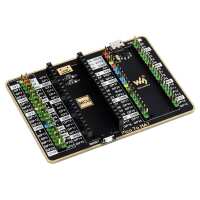
“Good looking board, nice physical layout that avoids the HAT clashing with the Pico.
However I have to dock a star because Pi GPIO23 and Pi GPIO24 are not connected to the Pico when similar products (like the SBC version) have.
Whether this is a problem for you depends on what HATs you're using and if you're willing to solder some bodge wires.”
“Excellent thing.
I have Pico W powered with this board thru USB charger and run scripts via wifi/webrepl.
Keeping pc ports nice and safe from anything unwanted while learning all sorts of hocus pocus.”
“A nice way to reuse HATs with Raspberry Pi Pico. Just a time saver for somebody who wishes to explore the capabilities of RPi Pico, or even to develop fast a prototype.”
“Awesome product. Cute and small, allows you to drive Raspberry Pi Hats from a Raspberry Pi Pico (or format compatible) microcontroller. Can also add a Pico Hat e.g. for wireless or a display.
This worked first time with a Pimoroni Four Letter Phat, Circuit Python and Adafruit's adafruit_ht16k33.segments library at https://docs.circuitpython.org/projects/ht16k33/en/latest/api.html#adafruit-ht16k33-segments. This is interface equivalent to https://learn.adafruit.com/adafruit-led-backpack/0-54-alphanumeric so just follow the instructions there.
Not all HATs will have an equivalent library e.g. the Pimoroni MicroDot PHAT might be a challenge, but the old EnviroPHAT is basically a collection of I2C sensors that do have support in the Adafruit library.
The pins on the Raspberry Pi 2x20 pin header are annotated with the GP pin numbers from the RPi Pico but not the RPi header pins (although they are colour coded). You need to cross refer these to the pinout for the HAT you are using. https://pinout.xyz/ is an excellent resource for this.”