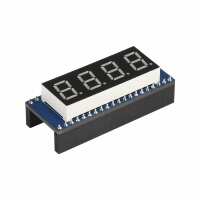
“It was driving me up the wall until I realised just how fast it needed updating, just to appear to be on constantly. Ended up using threading to offload the display part.
I used to make standalone 4 to 8 digit 7 seg displays that were sent simple serial data. I think I should have kept some as using these are annoying. I'll buy another, now that I understand them better.
Below is a link to my github project that uses these to display either cpu or ram stats.
https://github.com/amead77/PICO-8seg”
“Although this is a great little display, it's worth bearing in mind that as it is a multiplexed display it needs to be constantly refreshed (at least every 20mS) in a program loop. This can present a challenge if the Pico has to perform other tasks (such as reading switches or obtaining data from other peripheral devices such as a thermometer). I discovered this when programming a Pico in Micropython. The problem was easily solved by moving the refresh loop routine into the Pico's second core using the _thread function as a 'stand alone' program.
Similar displays from other sources exist which use the same 74HC595 shift register but using one shift register per display digit. These devices can display static data i.e. they only need to be written to when updating the data. If you're happy with the multiplexing (rather than static) display, this is a handy little display especially as Micropython _thread readily allows the multiplexing function to run as a completely independent task.”
“Haven't tested yet, but looks good. Cones in a cool little box in a anti-static bag with some protective foam. Has a little screen protector to prevent scratches in transit. Looks cool, cant go wrong for £3.90! Would be cool if it had a button or 2! Very cool, recommend.”
“Works amazingly, takes more force than expected to remove from the GPIO headers once plugged in, but I guess that means it definitely won't fall off! Would recommend.”