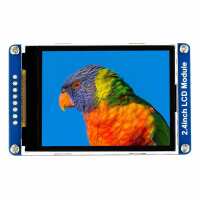
“Absolute doddle to get the hardware going. Driving with python is easy using the example library. Makes a super lightweight display for my weather station.”
“The online development resources from Waveshare show that this TFT module should have VCC connected to 3V3. The wiring examples on the PiHut page also show a connection for the Raspberry Pi to 3V3, whereas the Arduino Uno is connected to 5V. With the display connected to 3V3 the screen is white with no test patterns displayed. Only after checking the connections several times and testing various versions of code, did I decide that there were two possibilities. 1) The display was faulty, or 2) despite the majority of diagrams showing that VCC should be 3V3, that it was in fact 5V. I could see on the bottom of the PCB that there are a number of SMD resistors which are clearly there to allow interfacing to signals of 5V, so (with some trepidation) I connected VCC to 5V, and "Voila!" ... it started working. I also confirmed that the display will not function when connected to 3V3 by powering it from a bench power supply, just in case the problem was due to a volt drop from the laptop's USB port.
Very frustrating to get working, especially since it was such a simple problem. Once working though I was able to drive this display from both an Arduino Uno and Nano. I found the Adafruit_ILI9341 library to be the easiest to use.”