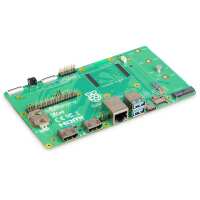
“Ideal for tinkering with CM5 before deployment. Shame that no jumpers supplied with the board for flashing to eMMC. Had to use rpiboot built from source on Linux machine.”
“Great for what it is, but it could be shrunk down a lot, and while it has 4 display outputs, it's somewhat lacking in USB connectivity, although that is technically a limitation arising more from the compute module itself”
“To install an OS like OpenBSD, you may not boot to HDMI but only via a serial console, serial cable so better to watch if these 3 pins are really soldered to that I/O board or not. For 19 pounds, I'd expect it and buy it without checking. That's those 3 unsoldered miniature holes above the white connection. By default, CM5 Lite boots via SD card slot, meantime, surprisingly, that I/O board accepted micro SD cards but didn't hold either of 3 types of micro SD to SD card adapters (new once that support 200-300MB/s). I've successfully used these same adapters for other boards like on Orange Pi 5, Starfive Vision2, etc without such a problem.
Best regards,
J. Vysvader”
“Super small but packed with IO ports to open capability of CM5 module. It took me a while to realise why it wouldn't boot from SD but having discovered that feature of non-lite CM5's it's been rock solid ever since. Has loads of space for separate sandwich boards connections which will come in handy on my projects. Purchase process was a breeze and Pi Hut delivered next day.”