“Great PCB with lots of features and great when used in conjunction with the small Zumo Robot and the MicroMetal N20 Motors (with encoders). My only disapointment was that it couldn't drive the larger yellow DC motors that come with the Waveshare Robot Chasis (or commonly found on Inexpensive Robot Chasis). For me the main benefit was that all the features of the PCB worked with MicoPython rather than CircuitPython :)”
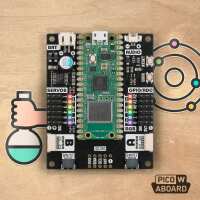
“The Inventor 2040 W is an excellent choice for experimenters who are building small, wheeled robots. At the centre of the board is the Raspberry Pi 2040 W, which is identical to its predecessor but with the addition of a wireless interface. Surrounding the 2040 W are a whole load of useful connections, notably a TI DRV8833 dual H-Bridge motor driver. The connections to the motors are made using six-way 1 mm pitch JST connectors. Matching ribbons are available which mate with a tachometer board on the back of a standard MicroMetal motor and gearbox. By far the cleanest, most straightforward way of connecting to motors I have experienced.
Other connections include the footprint for six RC servos, and on the opposite side of the board are similar pins to break out spare ports including the analogue inputs. There are two JST connectors for the IIC ports, using the standard format. An additional row of holes can be populated with pins for a more ad hoc connection to the IIC port.
An audio amplifier is a nice touch, driven by a single port, as are two rows of addressable RGB LEDs.
So far, so good. Experimenters who are used to having all port pins available, may have to re-think their application because several pins are used internally on the PCB. If your application requires additional parallel I/O, for example from touch sensors, then a good choice is the PCF8574 port expander, which gives you back eight I/O pins via the IIC.
This board is a lot of technology for 34 pounds, and will suit many applications directly. In my case, I had it running an "obstacle avoider" robot within an hour of receipt. Now I shall have to learn how to programme the wireless interface!”