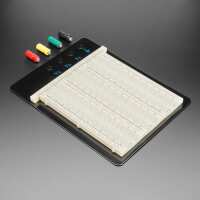
“The electrical contacts only grip jumper wires or most components I've tried loosely. Items such as Arduinos or ESP32 with headers are held in firmly and make good electrical connections but just about everything else are so loose that prototyping is just about impossible due to intermittent electrical connectivity.”
“I found the breadboard of very poor quality.
Components inserted into the breadboard didn't always make good electrical contact causing inconsistent behaviour in the circuits built on it.
The glue on rubber feet had perished. After glueing the rubber feet in place, the board flexed too much when inserting components in the middle of the board.
The posts were of terrible quality; I had to use WD40 to unscrew them.
I ended up buying a different breadboard; cost twice as much but does have the problems I highlighted above.”
“The Large Solderless Breadboard is fit for purpose however, I found that the adhesive on the rubber feet stand-offs had completely perished so superglue was needed.
Additionally, as there were no instructions provided I managed to break off the thread of one of the coloured posts because I hadn't loosened the post screw first before attempting to anchor it to the breadboard with the provided hex nut.
Those issues aside, the black backing board is made of a fairly weighty bit of metal on which the power posts and breadboard array is mounted.”
“I have this breadboard. It honestly makes doing projects so much easier. I can easily space out all my components and not have my hands getting in the way. The rows of power and ground make it easy to run a 3.3v, 5v and two ground rails from the pi, on another rail you can use an external power supply, giving you another 3.3v, 5v and two more ground rails.
I would recommend this to anyone with any experience level. 100% worth it!!”