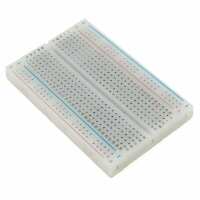
“Very useful for small projects, however a usage guide might have been nice as I am a beginner and had to watch a bunch of tutorials to understand where to put different pins.”
“My Pi nano pins were bent trying to insert into this breadboard. Even the jumper wires would not go in without a fight. Once in, there was virtually no effort needed to remove them. Absolutely useless.”
“These are acceptable, but only because they are also extremely cheap. I have found them quite frustrating to use, because of the inconsistency of the contacts and often considerable difficulty in insertion. It seems that the underlying contact parts are not that well made, and this makes them unreliable. Many components now have very thin terminations (e.g. the optical break sensors' flying leads, the standard 1% resistors, etc) and these simply pop out of the breadboard because they are not that well gripped.
The best wire gauge seems to be about 24. 22 is difficult to insert. Getting an Arduino Nano's set of header pins to insert required a worrying amount of force.
I'd only choose these again for something where all the connections are relatively self-supporting and medium thickness - perhaps they are good for conventional chip packages like opamps or 74 series. Otherwise, I think I'd be happier to pay much more for a higher quality breadboard with really good spring connection behaviour.”