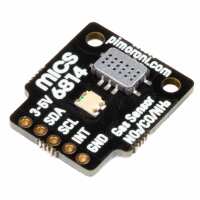
“This sensor has surprised me; it includes an LED. Quite interesting, it’s the first of these Breakout sensors I’ve seen with one (not counting LED matrices).”
“Device itself: 5*
Ease of use: 5*
Incorrectly programmed i2c address and no word of that or the solution on the product page OR in the github 'start here' site: 1*
so for anyone who tries to use this and gets errno 121 i/o error:
sudo i2cdetect -y 1
(this will show i2c addresses of attached devices, if it shows 0x18 rather than the 0x19 specified in the libraries and on the chip then:
i2cset -y 1 0x18 0xFE 0x10
i2cset -y 1 0x18 0xFD 0x19
(this will reset it to 0x19)”
“Super easy once I figured out that it was flashed with the incorrect I2C address (0x18 instead of 0x19). It was easier to modify the address in the .hpp library header file than flash the correct address onto the Breakout. Readings seem a bit high for CO but working on calibrating it.”
“Another great sensor that is almost 'plug and play' - apart from the fact that some came programmed with the wrong hex address so the example code needed modifying. That said, Pimoroni were on top of the problem and responded rapidly with the solution. Once again, more accessible and detailed documentation would aid understanding of the device and how to develop and modify applications using it. This is particularly true of the function of the onboard multicolour LED.”
“Very pleased with the breakout garden system overall, which, with the likes of this sensor, is giving me an easy way to learn more about Python and environmental monitoring & logging data. I've had the most niggles with this one of the four sensors I'm trying, including it having a different I2C address at first, which the support team quickly helped me resolve (and correct). Handy having the LED for status blinks. I would like more documentation for the library.”