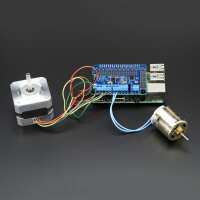
“I’m planning to use this as part of an Amateur Radio project, written in Golang, to point an aerial at a satellite and track it across the sky. The attraction to me is that the hat uses i2c so I can minimise the number of IO pins, I’ll need others for a GPS and some other peripherals.
It took me about 15 minutes to solder the connectors to the board. Make sure you have the screw connectors face the outside of the board before you solder them. I’ve rated the board as good because I think it’s a little expensive.”
“Borders on a waste of money. The python library is limited at best; no means of current readout or detection; no means or feedback on error conditions: e.g. motor jammed. No means of constructing positional feedback, even when using steppers (duh! the point about current feedback?!).
Should have spent the money designing and making my own shield from scratch.”
“Using it to drive 4 dc motors (2 in series) and a hefty stepper motor for an obstacle avoiding robot. Works great. Would like some better explanation on the additional pwm channels on the board however.”
“The product is working as it have to be, but i had to figure it all out by myself. no documentations of working c# code. no schemes for how to connect the pi with a IR sensor (stacked).
Good product Bad suppor/documentations
BTW David you are able to use C# with .net core”