Login
Start Free Trial Are you a business? Click Here

Antonio Carvalho Bouzouki PTB308 Reviews

5 Rating 12 Reviews
Read McNeela Music Reviews


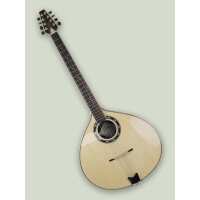
Antonio Carvalho Bouzouki PTB308
This is an Antonio Carvalho Bouzouki, handmade in Portugal. The sides and back are Koa wood and the top is solid Spruce. It has an Ebony Bridge and fingerboard and arched top and 24 frets. With a full sound it is ideal for Irish music.
Founded by Antonio Pinto Carvalho in 1976, APC Instruments is a Portuguese company with over 40 years’ experience in the manufacture of high-quality string instruments. Carvalho, a descendant of the famous 19th-century school of guitar players in Porto city, has been a luthier since 1961, having learned the art from his grandfather. Today, APC Instruments is one of the largest producers of high-quality instruments in Portugal.
Key Features of the PTB308 Bouzouki
Top: Solid spruce / Cedar
Back and sides: Koa
Strings: Steel, Tuning - (1st) D, A, D, G
Finish: Open pore
Product Features
Rosewood Bridge and fretboard, Arched top
Big full sound, perfect for Irish chord style playing
Single die-cast machine heads, Truss rod
Product Specifications
Top nut width: 38mm
Scale length: 645mm
Body width: 380mm
24 frets
Body depth: 9cm
Weight: 3.00 kg (approx)
Made in: Portugal
Please note that photographs are to be used as an illustration guide. Aesthetic specifics can change due to different batches of production by Antonio Carvalho's workshop. However product specifications remain the same.
ESTIMATED SHIPPING TIMES: 
IRELAND (Next Day)
UK (5 - 7 days)
EUROPE (7 days)
USA and CANADA (7 - 10 days)
REST OF WORLD (10 - 14 days)
 

Visit Product Page

Phone:

18322432

Location:

Unit 137 Baldoyle Industrial Estate, Baldoyle,
Unit 137 Baldoyle Industrial Estate, Baldoyle
Dublin
D13 X958

Happy customer, quick and secure shipping to the US, no complaints!
Helpful Report
Posted 2 months ago
Shipping to the USA was timely and item was packaged and arrived with care . The staff at McNeela were extremely helpful with my Order assuring all my questions and conerns were answered. After playing guitars for 30+ years this was my very first Bouzouki. Appartently I chose wisely. This Bouzouki is asthetically pleasing with KOA and exhibits craftmanship with attention to detail. The instrument sets-up nicely offering great fretting action along the entire fretboard with no fret buzz. Perfect Intonation with good sustain and a great voice makes it ideal for my particulat irish strumming style.. ( I use a 0.71 mm DUNLOP GATOR GRIP Pick tapering the tip down to 0.61 mm )
2 Helpful Report
Posted 6 months ago
Author didn't leave any comments.
Helpful Report
Posted 1 year ago
I own both the McNeela Premium Electro Acoustic Irish Bouzouki and the Antonio Carvalho Bouzouki PTB308. Five stars for each of these bouzoukis. Both are wonderful instruments and splendid to play and to hear. However, these bouzoukis are different in several significant ways. I wrote this review to help someone who is trying to sort out which instrument to buy. This review was written after performing with each instrument during four, 90-minute shows my trio did over the span of two weeks. (Not sessions. Concerts. On stage doing a mix of tunes and songs.). Technical differences of importance. Nut Width: The Carvalho nut is more than ¼” wider than the nut on the McNeela. This quarter inch difference is more than a 22% change in the dimension between the two bouzoukis. Players with large hands may appreciate the wider nut. Players with small hands may find the larger nut size to be challenging when reaching for chord positions. The Carvalho also has a thicker neck than the McNeela. On balance, the Carvalho favors players with large hands or long fingers. Scale Length: The scale length of the McNeela bouzouki nearly 1.5 inches longer than the scale length of the Carvalho. This means The McNeela bouzouki requires a greater stretch to get the same chord or melody fingering. In practice I have found that both instruments feel good to play. But, the Carvalho, despite the shorter scale length requires a greater stretch for fingering than the McNeela. That’s due to the greater nut width on the Carvalho. The wider neck of the Carvalho spaces out the strings more than the McNeela. The Carvalho favors players with larger hands or larger fingers. I have small hands and short fingers. I can barely reach an octave on a standard piano keyboard. The Carvalho requires more concentration to keep my fretting hand open and flexible. I must be more aware of the reach when playing the Carvalho. The McNeela, for me, has a more natural feeling when I play. Tip for Those (like me) with Short Fingers: Tune the Carvalho bouzouki down a whole tone to A C G C. Put a capo on fret 2, This makes fingering a much easier reach for short-fingered players. The low tuning does not degrade the voice of the instrument. It still sounds great. The Voices of the Instruments ( I did NOT use the plugin capability of the McNeela bouzouki for this) My McNeela bouzouki has a spruce top. My Carvalho has a cedar top. Spruce generally produces a brighter voice. Cedar generally produces a more mellow voice. The McNeela has a flat top. The Carvalho has an arched top. In general arched top lute-family instruments tend to produce more mellow sounds and less sustain. Arch top, lute family instruments tend to have more “bite” than flat top instruments. That’s why arch top guitars are favored by jazz musicians. It’s why an arch top F-body style mandolin is favored by bluegrass musicians while a flat top A-body style mandolin is favored by old time musicians. Punch for the arch top. Twang and sustain for the flat top. The McNeela voice is balanced across the entire four pairs of strings. It’s a clear sound that supports both delicate ornamentation and strong back up chording. The intonation is perfect. And the voice up the neck is sweet and clear. There is no weak sound anywhere on the McNeela bouzouki. The instrument’s voice is well balanced and produces a very attractive tone. The Carvalho has a stunning low end in its voice. It’s rich, mellow, full. It’s very satisfying to play this instrument. You really feel inside the instrument. The bottom end is amazing. My choice of the cedar top was correct. The top range of the Carvalho’s voice with the cedar top is very bright. I can only guess that the top end with a spruce top might be too bright for my tastes. The strength of the Carvalho’s voice is much greater than any other bouzouki I have played. This is a loud instrument. It will hold up well in a large session or in ensemble. Suggestions for Both Instruments Would be nice to have a strap button already installed at the neck joint. While it isn’t hard to install a strap button, not everyone is comfortable drilling a hole in a $600 or $700 instrument. That means a trip the luthier and a bill. A small thing, perhaps. Which one to Buy? If the primary goal is to have a loud instrument with a deep bottom end and a detailed high end range, my choice would be the Carvalho. If the goal is a balanced, clear, sweet voice across its range, with lots of sustain, it’s the McNeela for me. If your hands are small and fingers short, lean toward the McNeela. If your hands are large and fingers long, lead toward the Carvalho. Or drop the tuning on the Carvalho and put a capo on fret 2 to accommodate short fingers. If you are playing mostly with friends or in a small session, lean toward the McNeela. If you are playing in a large session or with an ensemble, lean toward the Carvalho. Bottom line: I’m not parting with either of these marvelous instruments. Each has a unique voice. Each feels different to play. For me it’s not a matter of which is “best”. It’s the fact these two instruments deliver distinctly different performance voices. I love them both for different reasons. Which the bouzouki I choose to play depends upon the setting and size of the group. Each bouzouki has significant strengths. I’m very pleased to own both of these bouzoukis. For what it’s worth, my trio likes the Carvalho best for performing. They like the big, natural, open voice of the Carvalho. Hope this report of my experience with the two bouzoukis is helpful.
7 Helpful Report
Posted 1 year ago
Sorry, my very poor English. I want just to say: thank you for the very good service and a very good instrument. I am 75 years old Finnish guy but I'll try to learn to play that new one. I like Irish folk music and now I play guitar, 5-sting banjo, and mouth-harp. Greetings from South Finland Village named Asikkala! Aarno Tiihonen
3 Helpful Report
Posted 2 years ago
It’s a lovely instrument. I did replace the strings to ones I think I like for Irish Bouzouki. I am really pleased with it. It’s my first Bouzouki and I wanted to dip my toe in the water. (Probably in awe of musicians seen playing in Temple bar when I did some work in Dublin) I’m following the Irish Bouzouki book by Niall Ó Callanáin and Tommy Walsh published by Waltons. Thanks for shipping so fast the case I bought with it is superb also and well worth it.
2 Helpful Report
Posted 2 years ago
I'm very happy with this purchase. I really like the shape of it and the sound is very strong. I've tried other instruments which cost double the amount and the sound wasn't as impressive as this. Very good and strong instrument.
1 Helpful Report
Posted 2 years ago
Lovely Instrument Having tons of fun with this instrument - I've bought and learned to play maybe three dozen instruments decently well in my life and I can say that this is one of the most forgiving instruments I've ever touched, it sounds great out of the box and you can get going within seconds (as long as you already play a plectrum instrument of some kind). Action doesn't seem to be 100% perfect - there is some buzz on the high d string at higher frets - but that's a simple fix I can do myself (and the instrument after all comes with an allen key...).
1 Helpful Report
Posted 2 years ago