How likely are you to recommend this product to a friend?
Did you find this product suitable for sensitive skin?
What is the age of the user of this product?
What skin type or concern was this product purchased for?
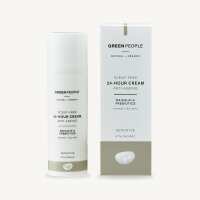
“This product really is amazing, and leaves your skin feeling baby soft. But I couldnt leave it on long because I have recently burnt all of my face via allergic reaction, so I had to take it off because it stung. I bought the cream to help with the burns and it didnt, but once I got other creams to help thisnone made my face feel really smooth and ready for makeup again. Thanks :)”
Thank you for your review.
We have been aware of the need to reduce the quantity of plastics used in packaging for many years. In fact, the plastic tubes that we use have been gradually reducing in thickness and weight over the years and the ones we currently use are significantly lighter than those we were using 10 or 15 years ago.
The airless bottles and pumps that we use for most of our creams and lotions enable us to use lower levels of preservatives than we have to use if we packed the same products into tubes or jars. Preservatives, by their very nature, have varying degrees of toxicity and many of the more powerful types have negative impacts on the environment. By avoiding the use of these more powerful preservatives we are minimising the environmental impact of our products.
We have investigated the availability and suitability of alternative sources of plastics for our packaging. The most promising are the tubes made from polymers derived from sugarcane. There are some as yet unanswered questions about the sustainability of the sugarcane production, and also the environmental impact of shipping the raw materials from Brazil to Europe for processing. It is also important to understand that the plastic produced from sugarcane is technically identical to that which is produced from crude oil and whilst it is totally recyclable, it will still pollute the planet if not disposed of properly.
Some companies have gone down the route of using plastic made from post-consumer recycled material. The drawback with that material is that most flexible plastics (i.e. PE and PP) will absorb colours and odours from whatever it has previously been in contact with. For example, if plastic that had a previous life as a bottle of orange squash, the orange aroma will still be partly present when the plastic is recycled. Likewise, if the plastic was previously used to hold cosmetics, it may well carry the fragrance of the original product over to the new tube material. This is not only undesirable and unpredictable, it could cause huge problems with products claiming to be scent-free, as well as issues with the organic certification bodies.
On a similar vein, at least one company is using plastics containing a proportion of ocean plastic. Similar background odour issues could be experienced with this material, with the added complication that plastics that have been floating in seas and oceans for any length of time may have absorbed potential toxins. These toxins, which can range from organophosphates, petrochemicals, heavy metals and any number of other toxic substances, cause discolouration of the plastic (instead of being white or clear it becomes grey) and some of these toxic substances may survive the recycling process and be present in the newly created packaging. Again, this would cause big problems with the organic certification bodies, and potentially with consumer health.
We have discussed the potential for using biodegradable plastics for our products, but at the moment the technology does not give a shelf-life for aqueous products of greater than a few weeks.
Alternative packaging materials to plastic are few and far between. In the case of our products, glass is the only viable material that can be used, which would significantly increase product costs and transport costs, greatly increase the amount of protective packaging required, and would present possible health hazards in some instances (i.e. using glass bottles in baths and showers is not a good idea).
As you will see from all of this, there is not a lot of choice that we can make. On the positive side, with the exception of our toothpastes and sachets, all of the packaging we use is readily recyclable and there is no reason for it ever to go into landfill. It can be recycled and used in a wide range of new plastic products where the presence of background odours is not an issue. Unfortunately, as mentioned the materials used for the toothpaste tubes and sachets have to incorporate a layer of aluminium as the jam in a PE/PET sandwich in order to provide an effective moisture barrier. This aluminium layer means that the plastic cannot be recycled. The alternative for toothpaste tubes is to use straight aluminium tubes, but these have to be lined with a lacquer to prevent interactions between the metal and the toothpaste. In the past there were some natural lacquers available, but nowadays they are only available lined with Bisphenol-A, a synthetic resin that has been shown to have potentially harmful effects on health. As far as sachets are concerned, we have been in touch with our current filler and he has advised us that at the present time there is no viable alternative material available. There is a thicker, all plastic film on the market, but when used for aqueous products such as ours it will only give a shelf-life of a few weeks which is just not viable.
How likely are you to recommend this product to a friend?
Did you find this product suitable for sensitive skin?
What is the age of the user of this product?
“I bought this scent free 24 hour cream for my face after using the eye cream which has similar ingredients. I use them together. I now no longer have Eczema on my face. It's just perfect not greasy keeps my skin soft all day. My skin looks radiant and normal. I'm so happy with this product. I really think the company is on to something in the treatment of Eczema. The bottles are too small for the amounts I need. I'd like to be able to use it on my body too. I can only use it daily on my face and on little sore patches on my body. The only other criticism is I can't tell when it is nearly finished. Maybe a little window down the side of the bottle will let me see when it's nearly done. Very happy”