Description
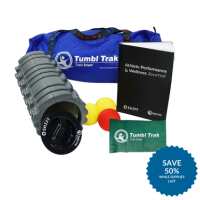
Dr. Dave Tilley, founder of Shift Movement Science is an internationally recognised expert in gymnastics sports medicine who is passionate about athlete progress via safe, healthy and effective preparation of the body. He combined his 20+ years as a gymnast, coach, researcher and medical provider, and teamed up with us at Tumbl Trak to create a kit that is a one stop shop for athletes who are concerned with maintaining optimal health. The kit includes the following carefully selected tools:
Foam Roller
Lacrosse Ball
Peanut Roller
Loop Band
Athlete’s Wellness Journal
Travel bag
This travel-friendly kit is designed to be compact and portable for on-the go wellness for hard working athletes! Between the kit itself, the training journal and the training videos, athletes will have everything they need to take care of themselves to get the most out of their performance and health.
Each purchase includes 7 videos from Dave Tilley that demonstrates how to use each product within the kit!
---
Specs & Docs
Foam roller has a screw-on end where the lacrosse ball and peanut ball will fit inside for easy transportation
The Travel Bag will fit everything along with an additional pouch for Conditioning Sliders if you choose to add them
Weight Limit: 91kg
Package Details: 51cm x 36cm x 23cm
---
Bonus Videos
Pre Practice Soft Tissue PrepA whole body soft tissue preparation is one of the best things that athletes can do before they start a practice. It helps to increase blood flow to muscles, reduce perceived soreness and start the process of getting mobility ready for what movements may come in training. We break down the basics of what athletes can do for a quick and efficient whole body roll out.
Shoulder Mobility ComplexOverhead shoulder mobility is one of the most important things for athletes to measure, improve and maintain. There are a variety of muscular groups that often get stiff and others that might get undertrained. In this video, we break down a specific complex to help improve overhead mobility using soft tissue care, specific stretching, active flexibility drills and technique work.
Wrist Mobility ComplexThe wrists are commonly a site of soreness and limited mobility in athletes. It’s important to make sure that the soft tissue of the wrist, along with the joint itself. We break down how to go about this in a quick circuit that can be easily used.
----
Right/Left Split Mobility ComplexRight and left splits are an element that many athletes in aesthetic sports like gymnastics, dance, cheerleading or circus are aiming for. It’s often times overwhelming to find specific, efficient circuits that can help. In this video, we break down the soft tissue, stretching, active flexibility and strength work that can assist in achieving full splits.
Straddle Split Mobility ComplexFor anyone in aesthetic sports like gymnastics, dance, cheerleading or circus, having full hip mobility into a straddle position is something many people work for. There are a variety of problems that can come up limiting this motion. In this video, we highlight some of the key elements to focus on when doing complexes to improve straddle split mobility.
Leg Tightening ComplexHaving good form and ’tight’ legs during skill work is important for gymnasts and other sports that use jumps, leaps and execution skills for scoring. In this video, we break down some easy exercises that athletes can use at home to improve this.
Ankle Mobility ComplexLimited ankle mobility is often times an issue for many young athletes, that can create problems both in performance and possible injury risk. A combination of soft tissue work, joint mobility and strength is often needed to help improve this. In this video, we cover some of the easy exercises that can be done to assist in improving ankle mobility.
---
FAQs
Is there room in the bag for grips and other items?
Yes, there is a bit of extra room in the gym bag for addtional like Conditioning Sliders or Sticky Toes.
Is the journal blank inside or do the pages have specific questions or prompts for the athletes?
The journal is comprised of daily pages, weekly pages, monthly pages and 'year-in-review' pages. Each page indicates how to complete each page and/or section. Here is a video that helps to explain how the journal works.